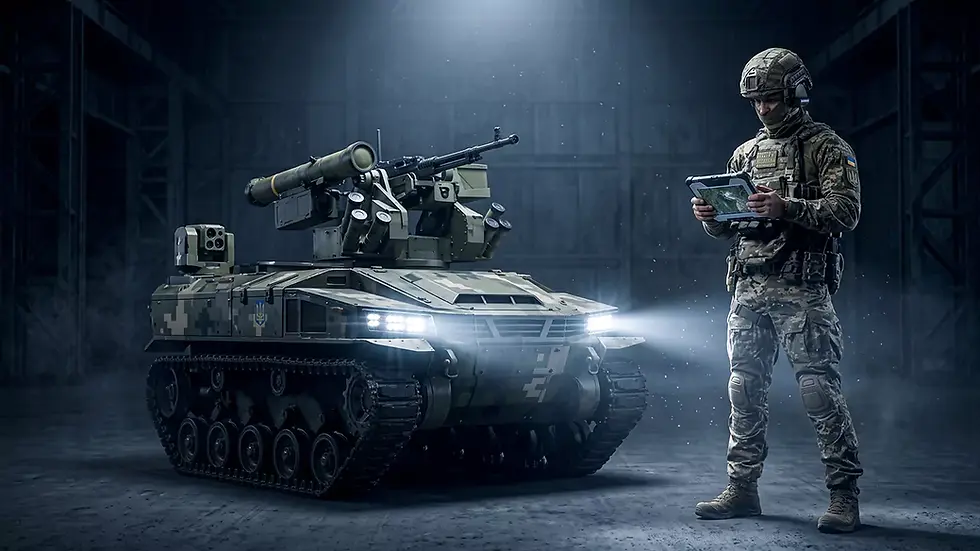
How PAWELL Battery Packs Help Implement the Air-Land-Economy Strategy in Ukraine

Updated: Jul 23

Modern warfare is increasingly turning into a technological confrontation, where victory is determined not by mass and caliber, but by speed, precision, and the efficient use of resources. These are the principles behind the Air-Land-Economy strategy, introduced in 2026 by Minister of Defense Mykhailo Fedorov as a key development direction for the Ukrainian Defense Forces.
Public attention usually focuses on the drones themselves — their range, warhead, and targeting autonomy. However, the true combat effectiveness of any UAV relies on a component rarely mentioned in briefings: the battery pack. It is the battery that determines whether the drone reaches its target, whether it can carry its payload, and whether it operates flawlessly at the exact moment of the attack.
What is the Air-Land-Economy Strategy?
Air-Land-Economy is a defense strategy that Fedorov and the Ministry of Defense team aim to implement through three pillars:
Air — defending airspace and intercepting enemy targets;
Land — containing the enemy on the ground, destroying their equipment and infrastructure at operational depth;
Economy — depleting the Russian economy through disproportionately high losses compared to the cost of the strike capabilities used.

In simple terms, the strategy's goal is to inflict maximum damage on the enemy using cheaper and more precise means, saving soldiers' lives and forcing the aggressor to incur costs that make continuing the war economically unviable. The Ministry of Defense assigns a key role in achieving this to unmanned systems — and this is exactly where a drone's range, precision, and reliability depend directly on its battery.
Middle-Strike Drones — The Domain Where Range Decides Everything
Today, the "Land" pillar is largely implemented through the middle-strike drone class — medium-range UAVs that bridge the gap between tactical FPV drones (a few to several dozen kilometers) and long-range deep-strike platforms designed for hundreds of kilometers deep into enemy territory.

Middle-strike drones typically operate at a distance of 30–300 km behind the frontline, targeting assets that determine the combat capability of the enemy's forces:
Fuel convoys and logistics hubs;
Ammunition depots;
Command posts and communication nodes;
Air defense and EW (Electronic Warfare) systems;
Equipment in the near and middle rear.
These drones operate beyond the operator's line of sight, thus requiring not only range but also precision against moving and small targets — terminal guidance modules, additional communication channels, and more complex navigation. Yet, no matter how "smart" the onboard computer is, its limits are always defined by a single physical metric: how much energy the drone can carry into the air and how long that energy will last in flight.

The Battery is Not a Consumable, but an Element of Combat Effectiveness
In modern FPV and middle-strike platforms, the battery affects much more than just flight time. The quality of the battery pack directly dictates:
The operational range of the combat mission;
The target engagement radius;
The ability to carry a heavier payload (warhead);
Flight stability during high winds and maneuvering;
The climb rate and drone controllability;
The overall reliability of the mission — from takeoff to the final attack.
In other words, a high-quality battery is not a "consumable," but a full-fledged component of the drone's combat capabilities, defining mission success just as much as the frame design or targeting algorithms.
Range: How Battery Chemistry Translates into Kilometers Behind Enemy Lines
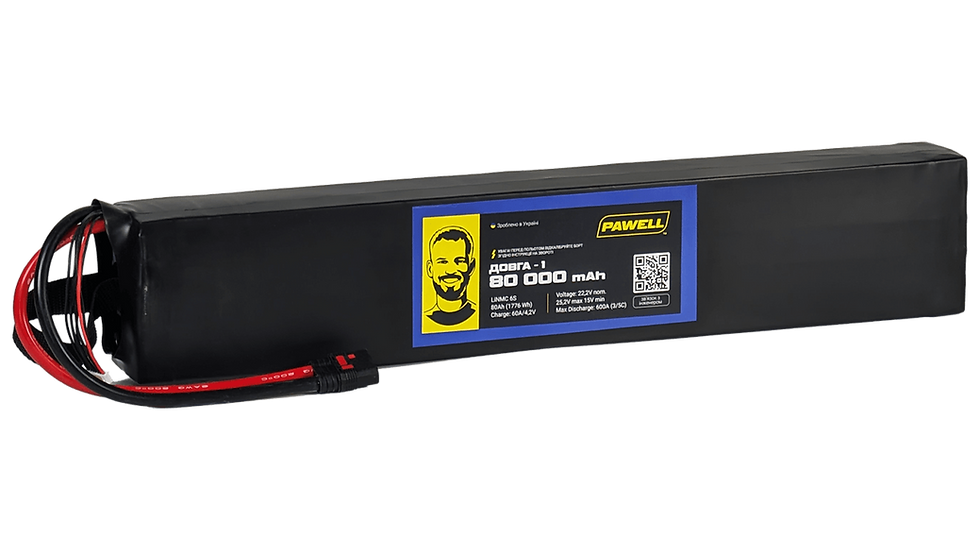
The most noticeable effect of a quality battery pack is the increase in range. In PAWELL's own testing, switching from standard Li-ion chemistry to Li-NMC — the same chemistry used in electric vehicle batteries — allowed a POSTMAN-type drone to fly 197 km with a 15 kg payload instead of the standard ~135 km, and return with a reserve charge.
This isn't just an increase for the sake of it. Higher energy density at the same battery weight means the drone manufacturer gets a choice:
Fly further on the same platform, reaching targets previously considered inaccessible for this class of UAV;
Or carry a heavier payload while maintaining the previous range.
For middle-strike drones, this is crucial, as range is not an abstract specification sheet metric, but the strict boundary defining whether the drone reaches a specific logistics hub or not. The difference between 135 km and 197 km is the difference between striking a frontline depot and striking a facility the enemy previously considered a safe rear area.
Expanding the Strike Zone: Every Kilometer is a New Target
The logic of the Air-Land-Economy strategy aims for a systemic effect, not isolated hits. When the average range of attack drones increases thanks to the battery, the zone where the enemy can no longer safely position equipment, fuel, and personnel expands. Essentially, this means forming our own anti-access/area denial (A2/AD) zone — a space where airfields, railway junctions, and depots deep in the rear become regular targets rather than exceptions.
The battery provides the energy reserve necessary for the drone to:
Cover a greater distance to the target;
Execute complex flight paths bypassing air defense and EW systems;
Maintain a sufficient charge level for the final attack phase — diving onto the target;
Compensate for additional energy losses when flying in adverse weather conditions.
This dynamic is already visible in practice: in 2026, middle-strike drones systematically target fuel logistics in occupied territories, forcing the enemy to find detour routes that extend the supply chain by 1.5 to 2 times. Every such detour means additional fuel costs, lost time, and increased convoy vulnerability on the road. Expanding the strike radius by dozens of kilometers via battery upgrades directly multiplies the number of assets subjected to this pressure.
Payload: More Impact Per Kilogram
Beyond range, an energy-efficient battery impacts the payload capacity. The optimized weight of the battery pack allows the drone to carry more explosives without altering the airframe design or installing more powerful motors.
This means a single middle-strike drone can reliably destroy a heavier, more expensive target — such as a tank, EW station, or air defense launcher — instead of merely causing partial damage. Since the combat effectiveness of the system increases without a significant rise in its cost, this directly aligns with the "Economy" criterion of the strategy: maximum results for minimal resources.
Reliability in Combat Conditions
A combat sortie involves sharp temperature fluctuations, high discharge currents during maneuvering, and countermeasures from enemy EW systems. Even a few percent of capacity loss or a voltage drop at the worst possible moment can determine the outcome of the entire mission.
A high-quality PAWELL battery pack guarantees:
Stable voltage under high loads;
Predictable performance throughout the entire flight;
Reduced cell heating;
High discharge rate during intense maneuvering and evasion;
Sufficient energy reserves so the drone doesn't lose power during the critical final attack phase.
For operators, this means fewer risks of losing a drone due to a lack of power at a critical moment — and consequently, a higher percentage of successfully completed missions.

Economic Asymmetry: How the Battery Reinforces the Third Pillar of the Strategy
The "Economy" pillar is built on cost asymmetry: a drone costing a few hundred to a few thousand dollars can disable equipment or infrastructure worth orders of magnitude more. The battery influences this asymmetry directly — the further and more accurately a relatively cheap platform flies, the less need there is for expensive long-range munitions or risky operations to achieve the same effect.
And when the enemy is forced to constantly extend logistics routes, reinforce rear air defenses, and disperse depots and convoys, these are economic costs in themselves — exactly the type of attrition the Ministry of Defense factors into the Air-Land-Economy formula.
Conclusion
The scaling of unmanned systems announced by the Ministry of Defense of Ukraine is impossible without creating a stable, domestic supply chain for critically important components. Batteries are precisely this foundational link. The daily operational intensity of the Defense Forces depends on their technological sophistication, availability, and uninterrupted production within the country.
For the PAWELL team, the development and manufacturing of high-class battery packs is not just about supplying consumables to the frontline. It is a direct engineering contribution to the range, precision, and reliability of Ukrainian unmanned systems. We are building the energy foundation to fulfill a national objective: to make the continuation of aggression so expensive and technologically impossible for the enemy that it completely loses any sense.
Developing solutions for the integrated frontline network?
The PAWELL engineering department will help unify the power supply for your UAVs and ground platforms. We will engineer and ensure the serial supply of reliable power modules tailored to the architecture of your ecosystem.