DJI Matrice or Autel EVO Max: Which Battery is Better for a Reconnaissance Drone?


When a unit or an operator chooses between the DJI Matrice and the Autel EVO Max, the question is rarely "which camera is better." In real field conditions, at sub-zero temperatures and under maximum load, another factor decides everything: how long the drone can actually stay in the air over the target, and what to do with the standard batteries when they lock up or lose capacity.
PAWELL engineers regularly work with the power subsystems of modern UAVs. In this article, we provide an honest technical comparison of the two most popular "enterprise-level reconnaissance drone" platforms, along with a concrete answer to the power issue: why PAWELL's parallel "SPARKA" batteries — 7,500 and 11,000 mAh — have become the go-to solution for operators of both systems.
DJI Matrice and Autel EVO Max: Who is Who in Reconnaissance
Both manufacturers offer equipment with similar purposes but different engineering solutions.

DJI Matrice (3 and 4 series lineup — M3T/M3D, M4T/M4E) is DJI’s flagship enterprise platform. These are drones with an integrated RTK module for centimeter-level positioning accuracy, thermal and telephoto modules, and support for autonomous docks (Dock 2/3) for unmanned deployment. In combat conditions, this lineup is most often used for artillery spotting and tactical-depth reconnaissance — exactly where both positioning accuracy and optical quality are critical.

Autel EVO Max (4T — thermal version, 4N — night mission version) is DJI’s main competitor in this segment, and at the same time, a popular alternative for units that deliberately diversify their fleet across multiple manufacturers. According to defense procurement tenders, the EVO Max 4T/4N is regularly purchased for territorial defense and combat brigades — primarily for night reconnaissance due to its powerful thermal imaging channel.
There is no universal winner between DJI and Autel drones — the choice depends on the application scenario, equipment weight, mission range, and autonomy requirements.
Comparison of Key Specifications
Parameter | DJI Matrice (Series 3/4) | Autel EVO Max 4T/4N |
Max. Flight Time | up to 49 min | up to 42 min |
Max. Transmission Range | ≈15–25 km | up to 20 km |
IP Rating (Protection) | IP55 | IP43 |
RTK Positioning | Yes, built-in module | Optional |
Standard Battery | Li-ion/LiPo HV (hot-swap system) | Li-ion 4S, ≈8,070 mAh |
Estimated Drone Price | ≈220,000–250,000 UAH | ≈195,000–290,000 UAH |
*Exact specs and current prices should be verified on official manufacturer pages and with suppliers before purchase — both companies regularly update firmware and configurations.
The main takeaway from the table: both platforms confidently cover reconnaissance tasks, but neither flies "as long as needed" — for both DJI and Autel, time in the air is limited by a single standard set of batteries. The only difference is how critically this is felt: the EVO Max has about 15–20% less standard autonomy than the Matrice, making the issue of additional power even more pressing for it.
Why Flight Autonomy Decides Everything in Reconnaissance
For strike FPVs, it's a question of speed. For a reconnaissance drone, it's a question of time over the target.
✓ More time in position — more information. Every extra minute in the air is another pass over the grid, another thermal frame, another verified coordinate.
✓ Fewer takeoffs — less unmasking. Every takeoff and landing is the moment when the operator and the drone are most vulnerable. If a single charge allows the mission to be completed without returning to position for a battery swap, the risk to the crew drops.
✓ Margin for emergencies. EW (Electronic Warfare), wind, route detours — all of these "eat up" the manufacturer's stated flight time. Extra capacity is a margin for returning home safely, not just for completing the task.
That is exactly why the question increasingly sounds not like "Matrice or EVO Max," but rather "how to make the drone we already have fly longer."
Limitations of Standard DJI and Autel Batteries
Both DJI and Autel equip their drones with "Intelligent Flight" batteries featuring proprietary Battery Management System (BMS) boards flashed for specific models. This means:
Capacity is fixed by the manufacturer — it is impossible to "boost" the standard battery to a higher capacity.
Replacing cells inside the standard battery is not intended by the manufacturer and is dangerous.
The only legal and technically correct way to extend flight time is through an additional power source connected in parallel to the main system, rather than replacing the standard battery.
It is exactly in this niche — certified parallel batteries, not "DIY" modifications — that PAWELL operates.
PAWELL Power Solutions: Two Versions of the SPARKA
PAWELL offers dedicated battery solutions for DJI and Autel that can be integrated into the platform's power system. Specific compatibility, wiring diagrams, voltage, and permissible operating modes must be determined for the specific drone model and battery kit version.
PAWELL's parallel "SPARKA" batteries come in two capacities, and these are not just two identical products "just in case" — it is a conscious choice between weight and airtime margin, tailored for different missions.

🔗 SPARKA 7,500 mAh — a compact version using high-voltage Li-HV+ cells, weighing only 370 g, providing approximately +20 minutes of extra flight time. This lighter and less bulky battery is optimal when maximum maneuverability and minimal impact on the drone's balance are crucial, such as for rapid flyovers without prolonged hovering.
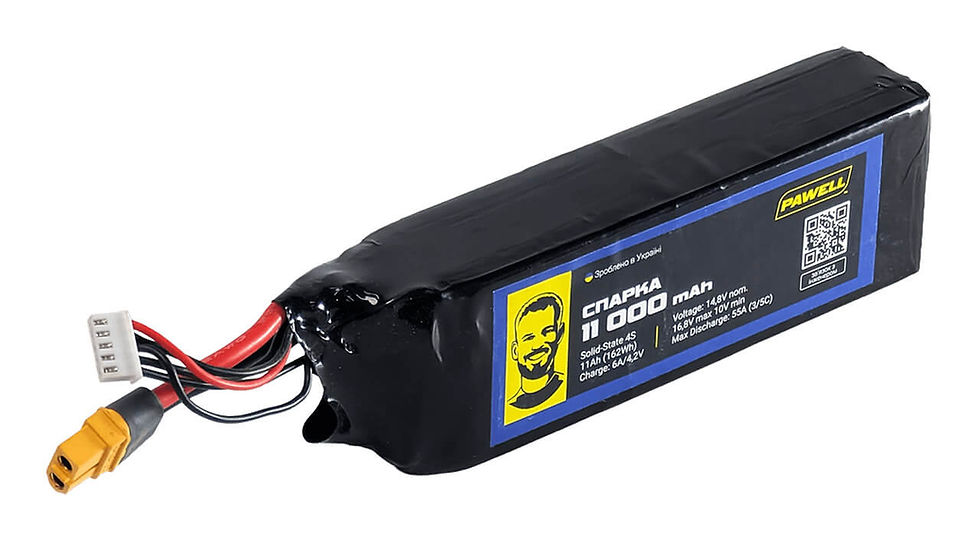
🔗 SPARKA 11,000 mAh — a version using Solid-State cells, weighing 506 g, providing approximately +40 minutes of extra flight time. Higher capacity and weight make this the choice for missions where time over target is the priority: prolonged observation, artillery spotting, or sector patrolling.
Both models are connected in parallel to the drone's standard power system (they supplement, rather than replace, the original battery) and are designed for DJI Matrice 3/4 series and Autel quadcopters.
Comparison of the Two Versions:
Parameter | SPARKA 7,500 | SPARKA 11,000 |
Cell Chemistry | Li-HV+ | Solid-State |
Nominal Voltage | 15.2 V (range 12–17.8 V) | 14.8 V (range 10–16.8 V) |
Capacity | 7.5 Ah (114 Wh) | 11 Ah (162 Wh) |
Peak Discharge Current | up to 75 A (10C) | up to 55 A |
Flight Time Increase | ≈ +20 min | ≈ +40 min |
Weight | 0.37 kg | 0.506 kg |
Dimensions | 130 × 77 × 18 mm | 150 × 32 × 48 mm |
Connector / Balance | XT-60 / JST-XH 4S | XT-60 / JST-XH 4S |
Operating Temperature | -20 °C to +60 °C | -20 °C to +60 °C |
How to choose between them:
Priority — maneuverability, minimal extra weight, compact profile → SPARKA 7,500 mAh.
Priority — maximum time in position, long observation or spotting missions → SPARKA 11,000 mAh.
Undecided — base it on the mission type: for short, frequent sorties, the lighter 7,500 is more beneficial; for rarer but longer missions, choose the 11,000.
Both versions of the PAWELL "SPARKA" share the most important features: a certified, mass-produced assembly with reliable XT-60/JST-XH connections, temperature resilience from –20 °C to +60 °C, and the same core principle — the secondary battery will not "fail" the drone with peak voltage drops during maneuvers.
Frequently Asked Questions (FAQ)
1. DJI Matrice or Autel EVO Max — which is better for reconnaissance?
DJI Matrice wins in base flight time and ingress protection rating (IP55). Autel EVO Max is often chosen for night missions and operations in heavy EW environments. Ideally, a unit should have both systems.
2. How to properly store DJI/Autel drone batteries?
Never store them completely discharged (this guarantees a BMS Lock) or at 100% charge (this leads to swelling). The optimal level is 50-60% charge in a room with a temperature of +15...20°C.
3. How much does the PAWELL SPARKA actually extend drone flight time?
It depends on the version: the 7,500 mAh provides about +20 minutes, while the 11,000 mAh provides about +40 minutes of extra airtime. The exact increase depends on the payload weight, temperature, and flight mode of your drone.
4. Does the additional battery affect the drone's handling and speed?
Insignificantly. The weight of both SPARKA versions (370 g or 506 g) is calculated to stay within the recommended additional payload limits for this class of drones, so operators do not register any noticeable loss in maneuverability. If maneuverability is the top priority, choose the lighter 7,500 mAh version.
5. How much does a PAWELL reconnaissance drone battery cost, and can I buy wholesale?
The price of PAWELL batteries depends on the batch size — special wholesale conditions apply for volunteer foundations, military units, and dealers. Please check the exact cost on the product page or by submitting an inquiry.
6. What is the warranty on PAWELL batteries?
12 months from the date of purchase for all battery systems, plus a drone replacement compensation program in the event of a confirmed battery defect.
DJI Matrice and Autel EVO Max are the two strongest platforms in the enterprise reconnaissance drone class, and the choice between them largely depends on the unit's specific task, rather than which manufacturer is "better." However, in both cases, flight autonomy remains the main limiting factor for mission effectiveness. PAWELL "SPARKA" is a certified, mass-produced Ukrainian solution available in two capacities (7,500 and 11,000 mAh), which adds between 20 and 40 minutes of airtime for both systems without significantly affecting the drone's handling.
Need a battery for your drone — DJI Matrice, Autel EVO Max, or another platform?
If you are an operator or technician of a unit utilizing DJI Matrice, Autel EVO Max, or similar reconnaissance UAVs, and you are facing BMS locks or a critical shortage of airtime — the PAWELL team is ready to provide effective solutions. Leave a request, and our engineering department will select the optimal power configuration for your task and budget.


