Nemesis UAV: Technical Specifications, Advantages, and Powering the Ukrainian Bomber Drone


The Ukrainian Nemesis heavy bomber drone is capable of lifting up to 10-15 kilograms of payload and penetrating dozens of kilometers behind enemy lines. Its main feature is the integration of the Starlink system. Thanks to this, the ground crew only launches the drone near the front line, while the operator can pilot the aircraft in complete safety, located hundreds or even thousands of kilometers away from the launch site (for example, in Kyiv). According to the manufacturer, as of early 2026, the Nemesis has completed over 150,000 combat sorties, and this number continues to grow steadily.
In this article, we will analyze the technical characteristics of the Nemesis UAV, its advantages and modifications, as well as explain why the power system for drones of this class differs fundamentally from standard FPV drone batteries, and what specialized solution the PAWELL team offers.
What is the Nemesis and Who Develops It?

The Nemesis is a heavy multi-purpose unmanned aerial vehicle of the "bomber" class, developed by the Ukrainian company UFORCE. The drone is designed to strike enemy personnel, lightly armored vehicles, ammunition depots, and fortifications at tactical and operational depths.
The engineering group that created the aircraft from scratch back in 2022 was subsequently supported by UFORCE, a powerful defense integrator. Besides the Nemesis line, their portfolio includes MAGURA unmanned surface vessels, R18 bombers, and unmanned ground vehicles (UGVs).
It is worth distinguishing between two concepts that are regularly confused even by specialized media:
Nemesis is the unmanned platform, a product manufactured by UFORCE.
The 412th Separate Unmanned Systems Brigade "Nemesis" is a military unit of the Ukrainian Defense Forces (part of the Unmanned Systems Forces). It was the fighters of this unit who were among the first to master and develop the combat application of the drone, which is why the name of the equipment and the name of the brigade often appear together in the news.
Important clarification regarding the name "Baba Yaga": This is not the proper name of the Nemesis, nor is it the name of any single specific drone. This is a collective term used by the Russian occupiers to refer to an entire class of heavy Ukrainian bomber drones (which includes the Nemesis, the Vampire, and models from other manufacturers). In other words, "Baba Yaga" is rather enemy jargon for a category of equipment.
Nemesis Technical Specifications
The dimensions of the aircraft are impressive: the distance between the four motors exceeds 1 meter, making it one of the largest UAVs in its class.
Parameter | Value |
UAV Class | Heavy multi-rotor bomber drone |
Manufacturer | UFORCE (Ukraine) |
Maximum Takeoff Weight | 37.2 kg (weight of the drone itself without battery — 11.6 kg) |
Payload Capacity | Optimal 6–10 kg (maximum up to 15 kg) |
Combat Radius | 10–12 km operational radius (one-way range — up to 20 km) |
Flight Time | Up to 45 mins (without payload), ~30-33 mins (with full payload) |
Communication and Control | Starlink terminal, secure radio channels, operation without signal |
Navigation | Multi-band satellite receiver (GPS, Galileo, BeiDou) |
Optics | Thermal imaging camera for night operations |
*Note: The table provides publicly available technical specifications of the base Nemesis platform. For reasons of crew safety and to preserve military secrecy, the exact operational parameters, control frequencies, and specifications of the latest UAV modifications are not disclosed in open sources.
Key Advantages of the Platform
EW resistance and independence from distance. Thanks to Starlink, the drone is controlled beyond the line of sight and radio horizon — the distance between the operator and the aircraft practically loses its significance as a limiting factor.
Rapid deployment. According to operators, upon arrival at the position, the crew is ready for departure in approximately 10 minutes: setting up the equipment, establishing communication, equipping the payload, and assembling the drone itself.
Night operations. High-quality thermal imaging optics allow for confident detection of a wide range of targets — howitzers, self-propelled artillery units, tanks, air defense and EW systems, as well as cargo vehicles, bridges, and crossings — even in the dark, when the activity of bomber drones is traditionally highest.
Mission flexibility. The flight range scales depending on the mass of the payload: up to 20 km with a 6 kg payload and up to 18 km with a full 10 kg. This allows the crew to balance between the depth of the strike and the power of the munition depending on the type of target.
Proven combat record. Over 150,000 completed sorties (according to the manufacturer's statement, data as of early 2026, with an upward trend) — this is not a demonstration figure, but an indicator of the real operational reliability of the platform in combat conditions.
Drone Modifications
In the spring of 2026, UFORCE expanded the Nemesis lineup with two new modifications:
Nemesis-mini: Approximately half the size of the base model, oriented toward local tactical tasks.
Nemesis-kamikaze: A one-way strike version of the aircraft, designed for a single target strike without returning to base (not to be confused with the "Bucha" kamikaze drone from the same manufacturer).
Powering the Nemesis: Why Standard Batteries Are Not Enough
The manufacturer does not publicly disclose the detailed specifications of the standard Nemesis battery system — this is expected for military equipment. However, the requirements dictated by the design of the aircraft itself are clear even without official specifications.
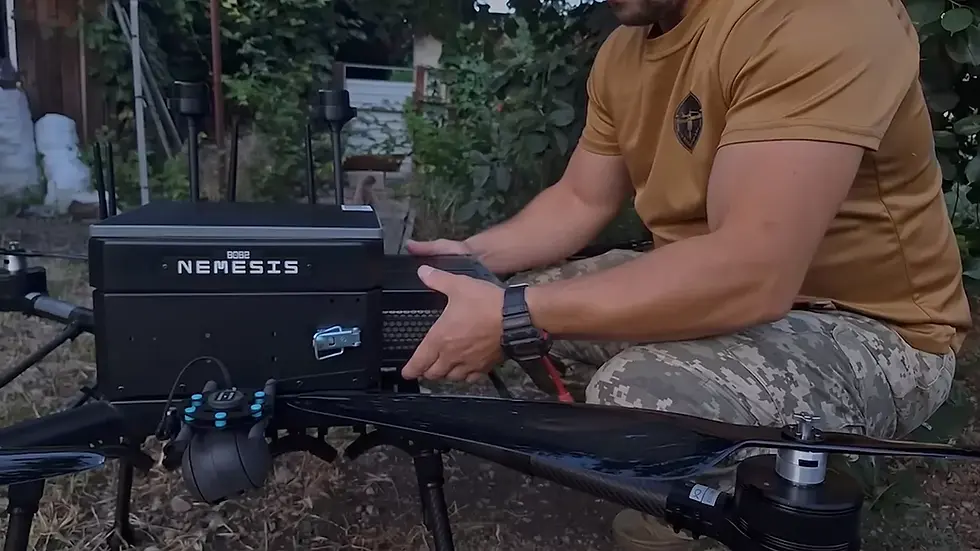
A heavy multi-rotor with a takeoff weight of ~37 kg, operating at ranges up to 20 km and constantly powering a Starlink terminal, places extreme demands on the power system:
High peak discharge current. Four powerful motors simultaneously lift the aircraft and a payload of up to 10 kg, so the battery pack must stably deliver high current without a critical voltage drop — otherwise, the aircraft loses controllability or range.
Consistent capacity output. Unlike short and boosted FPV flights, what matters here is not peak power for a few seconds, but stable operation for 30–45 minutes.
Resistance to charge-discharge cycles in field conditions, often without an ideal temperature regime — in winter, the performance of lithium-ion cells drops, and this must be factored into the pack's design in advance.
Readiness for instant replacement at the position. Since the entire deployment takes about 10 minutes, the battery must be ready to connect without additional diagnostics or warming up.
The Solution from PAWELL: Reliable Batteries for Heavy UAVs

The PAWELL team has directly faced these requirements when developing and modifying batteries for heavy bombers. Understanding the specifics of aircraft in this UAV class, we have created a specialized battery pack for the Nemesis that covers all technical needs:
Li-NMC (Lithium Nickel Manganese Cobalt) chemistry: Provides an optimal balance of high energy density and stable current output, outperforming classic Li-Ion and Li-Po, especially in freezing temperatures.
Configuration and capacity: The 12s format assembly with a capacity of 80 Ah (3552 Wh) guarantees the full completion of the mission even with an active Starlink satellite connection.
Extreme current output: Up to 300A at peak — a guarantee of zero voltage drop during sharp maneuvers.
Durable casing: The aluminum case (total weight ~13.2 kg) protects the cells from damage and acts as an effective radiator for heat dissipation.
Connectors: AS-250 power connectors prevent the melting of contacts under prolonged load.
Frequently Asked Questions (FAQ)
Who manufactures the Nemesis drone?
The drone is developed by the Ukrainian company UFORCE — a defense integrator that also develops MAGURA naval drones, R18 bombers, and unmanned ground vehicles.
What is the flight range of the Nemesis?
Up to 20 km with a 6 kg payload and up to 18 km with a 10 kg payload. The tactical combat radius (including the return flight) is 10–12 km.
How much does the Nemesis weigh and what is its payload capacity?
The maximum takeoff weight of the aircraft is 37.2 kg. The optimal payload capacity is 6-10 kg, but the drone has power reserves to lift payloads up to 15 kg.
Is it true that the "Baba Yaga" is exactly the Nemesis drone?
No, this is a common misconception. There is no single drone named "Baba Yaga" — this is a general term used by the Russians for an entire class of heavy Ukrainian night bomber drones from various manufacturers, including the Nemesis and Vampire.
How do the Nemesis-mini and Nemesis-kamikaze differ from the base version?
The Nemesis-mini is approximately half the size of the base model and is designed for local tactical missions. The Nemesis-kamikaze is a one-way version of the aircraft for single-target strikes. Both modifications were introduced in the spring of 2026.
What batteries are suitable for heavy bomber drones like the Nemesis?
Such aircraft require batteries with a high discharge current (up to 300A) and resistance to sub-zero temperatures. Assemblies based on Li-NMC chemistry (for example, the 12s 80Ah from PAWELL) in aluminum cases have proven themselves well, providing over 30 minutes of stable flight with a full payload and active Starlink.
Need a reliable battery for the Nemesis?
If you are an operator or technician of a unit operating the Nemesis or similar heavy UAVs, and you encounter premature battery degradation, the PAWELL team is ready to provide a solution. We customize the battery configuration, connectors, and casing dimensions to meet your technical requirements.


