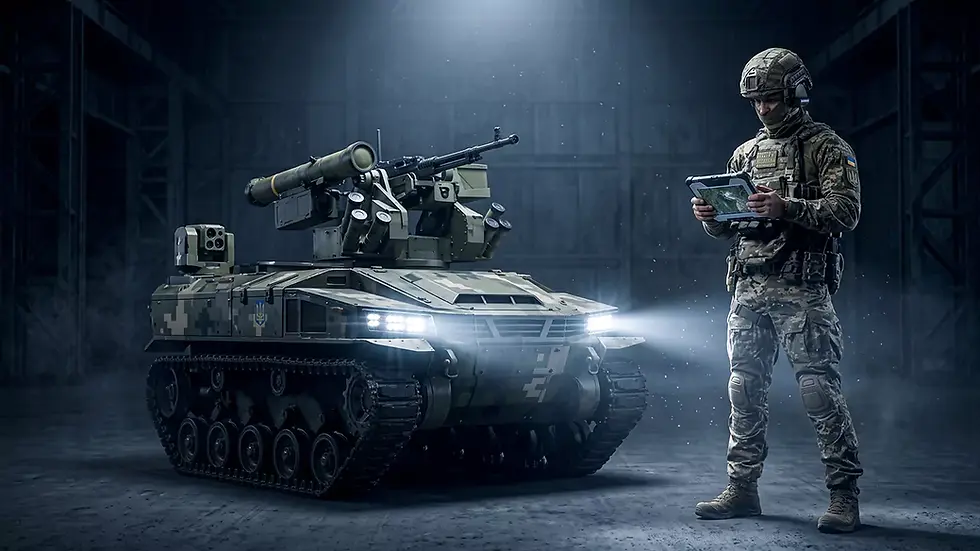
Solid-State Batteries: What They Are and Why They Are the Future of Unmanned Aviation


Every drone developer knows the dilemma: if you want longer flights, you fit a bigger battery. But a bigger battery is heavier, and the drone loses payload and range. LiPo and Li-ion have practically reached their limits and can no longer break out of this vicious circle.
Solid-state batteries can! They are already flying on Ukrainian UAVs. Here is a plain-language explanation of how they work and why they are the most promising power source for drones today.
A solid-state battery is a lithium battery that uses a solid electrolyte (ceramic, glass or polymer) instead of a liquid one. It stores roughly 30–50% more energy than a Li-ion battery of the same weight, is far less prone to catching fire and performs more reliably in the cold. For a drone, that means longer flights and more payload.
What Is a Solid-State Battery, in Simple Terms
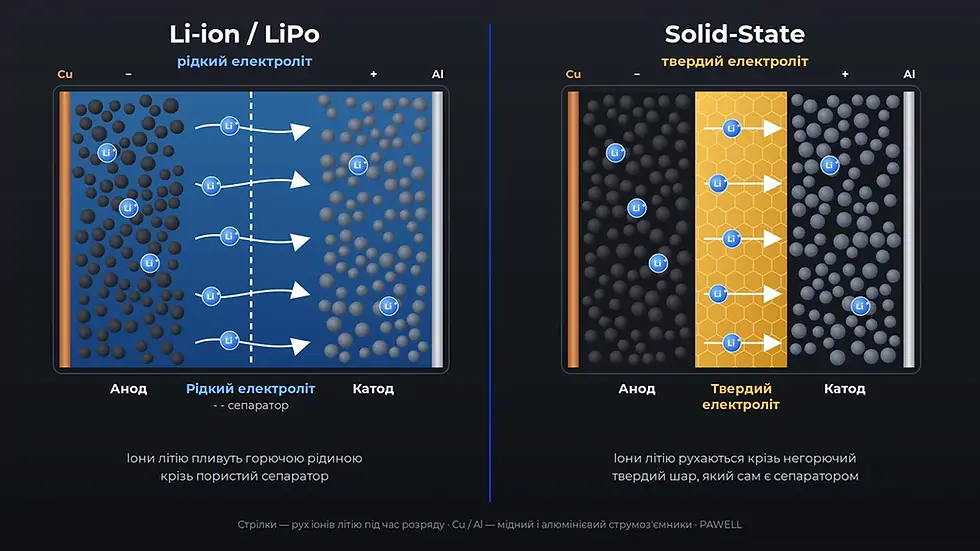
Every lithium battery has a "plus" (the cathode) and a "minus" (the anode). Lithium ions travel between them: one way while charging, the other way while the battery is working.
In conventional LiPo and Li-ion batteries, the ions travel through a liquid electrolyte. Think of it as a river carrying passengers. It is fast, but it is flammable, thickens in the cold and gradually "runs shallow" as the battery degrades.
In a solid-state battery, the river is replaced by a bridge: a solid electrolyte made of ceramic, glass or polymer. The ions cross from one bank to the other just as freely, but the structure is stable, does not burn and lets energy be packed much more densely.
! An important nuance: the cells used in drones today are mostly semi-solid-state. Their electrolyte is largely solid or gel-like, with only a minimal liquid fraction. Fully solid-state batteries are only now leaving the lab and remain very expensive. Semi-solid cells already deliver most of the technology's benefits and are produced at industrial scale. These are the cells the UAV market calls "solid-state".
Solid-State Chemistry: The Details That Change Everything
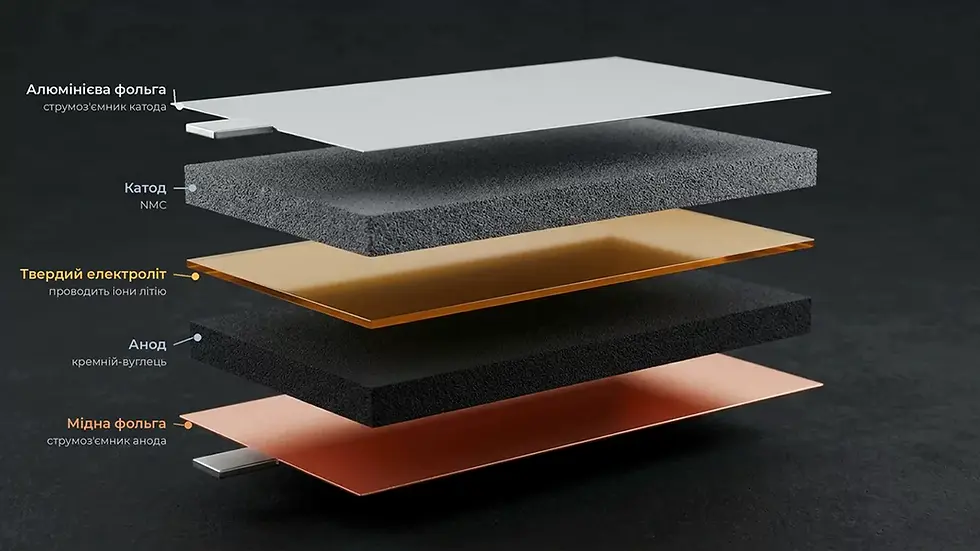
Solid electrolyte. Most often this is a ceramic (oxides), a sulfide or a polymer. Each type has its own balance of conductivity, strength and ease of manufacturing. But they all share the key advantage: they are far more stable than a flammable liquid.
High-capacity anode. This is the real revolution. Conventional batteries use a graphite anode, which stores relatively little energy. A solid electrolyte makes it possible to use silicon-carbon composites, which hold several times more lithium. The next step is an anode made of pure lithium metal. That is the maximum possible capacity, and it is the reason the whole world is developing this technology.
High-nickel cathode (NMC). It also packs more energy into every gram.
✓ Bottom line: the same energy in less weight and less volume.
4 Benefits Your Drone Will Feel
1. More flight time for the same weight. Solid-state cells store 30–50% more energy than Li-ion and 1.5–2 times more than LiPo of the same weight. You can spend that reserve on longer flights, a heavier payload or greater range. Or you can downsize the battery if the bay is tight.
2. Higher safety. Flammable liquid is the main reason lithium batteries catch fire when punctured, overheated or short-circuited. Solid-state cells contain very little of it or none at all, so the risk of a chain-reaction fire (thermal runaway) is much lower. For equipment that operates under fire and crashes, this is critical.
3. Stable in the cold. A liquid electrolyte thickens in winter, and the battery drains before your eyes. Semi-solid cells hold their voltage during discharge down to -20°C (-4°F), so winter flight times become predictable.
4. Longer service life. The solid electrolyte slows electrode degradation. The battery retains its capacity longer and withstands more charge–discharge cycles.
Comparison Table: Solid-State vs LiPo, Li-ion and LiFePO4
LiPo | Li-ion (NMC) | LiFePO4 | Solid-State | |
Energy per kg (cell) | ~150–200 Wh | ~220–280 Wh | ~90–160 Wh | ~300–400+ Wh |
Peak current | Very high | Medium | Medium | Medium–high |
Safety | Low | Medium | High | High |
Cold-weather performance | Weak | Medium | Weak | Good (down to -20°C) |
Best for | Light, fast FPV drones | General-purpose use | Ground vehicles, charging stations | Heavy UAVs, fixed-wings, bombers |
Do These Batteries Have Any Drawbacks?
The honest answer is yes, and customers should know about them.
Price. Solid-state cells cost more than conventional Li-ion and LiPo. But per minute of flight or per kilogram of payload, the difference often pays for itself.
Peak current. For most fixed-wing UAVs, reconnaissance drones and heavy multicopters, the power output is more than sufficient. For missions with extreme peak currents, such as light, fast FPV drones, classic LiPo batteries remain competitive. That is why every pack configuration has to be calculated for the specific airframe.
Charging in the cold. Like any lithium battery, they must not be charged at sub-zero temperatures.

✓ Operating tip: a solid-state battery can fly at temperatures down to -20°C, but it should only be charged above freezing (0…+45°C). For long-term storage, keep it at about half charge in a cool, dry place.
Who Should Choose a Solid-State Battery
Solid-state batteries perform best where every gram and every minute in the air counts:
heavy bomber drones such as Vampire, Nemesis and others;
fixed-wing UAVs for reconnaissance and artillery spotting;
DJI and Autel reconnaissance multicopters;
heavy long-range FPV platforms;
agricultural and cargo UAVs with heavy payloads.
Solid-State Batteries by PAWELL
PAWELL is a Ukrainian manufacturer of UAV batteries with its own production facility in Lviv. We serially produce high-quality batteries built on solid-state cells:
Solid-State 30,000 mAh: for heavy FPV drones;
Solid-State 40,000 mAh: the optimal weight-to-capacity balance for the Leleka-100 and FPV drones;
Solid-State 66,000 mAh: 1,564 Wh at 5.8 kg, peak current up to 330 A;
81,000, 90,000 and 118,000 mAh: for large UAVs and bombers;
SPARKA 11,000 mAh: for DJI and Autel drones.
✓ Every PAWELL pack is built with automated laser welding accurate to 0.01 mm, goes through quality control and comes with a 12-month warranty.

Need a different configuration? We serially produce solid-state batteries in any configuration for your drone model. Voltage, capacity, dimensions, connector and current output are all matched to your requirements. Our R&D team calculates the pack, and our production line ensures consistent quality even for large batches. Learn more about B2B cooperation 🔗
Frequently Asked Questions (FAQ)
What is a solid-state battery?
It is a lithium battery with a solid electrolyte instead of a liquid one. It is lighter, stores more energy and is safer than conventional Li-ion and LiPo batteries.
Why is solid-state better than LiPo?
It stores 1.5–2 times more energy per kilogram, is less prone to catching fire and performs better in the cold. LiPo only wins where extreme peak currents are required.
What is the difference between solid-state and semi-solid?
In a solid-state battery, the electrolyte is completely solid. In a semi-solid battery, it is mostly solid or gel-like with a minimal liquid fraction. Semi-solid cells are what drones use in serial production today.
Do solid-state batteries work in winter?
Yes, they can fly at temperatures down to -20°C. They should only be charged above freezing.
Can I order a solid-state battery for my drone?
Yes. PAWELL serially produces packs in any configuration. Contact us for a calculation.
Need solid-state power integrated into your product?
If you are developing new UAV platforms or want to dramatically extend the flight time of your existing drones, contact the PAWELL engineering team. We will design a battery built on advanced solid-state cells (or on Li-NMC or LiFePO4 if needed) precisely to your technical requirements: capacity, weight, current and connectors. We guarantee professional engineering calculations, production-grade build quality and reliability in the harshest operating conditions.